

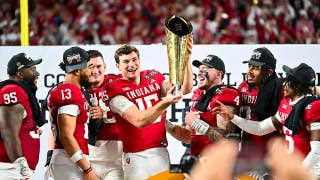


Legendary agent warns a MLB lockout would be 'self-destructive' to the sport
Leigh Steinberg tells OutKick in a recent interview why a lockout would be crippling to Major League Baseball amidst it's resurgence.
Barring a miracle, we are less than two weeks away from a prolonged work stoppage in Major League Baseball.
The Collective Bargaining Agreement between the 30 team owners and the MLB Players Association expires in early December, and the two sides, despite some bargaining between them, are no closer to a deal than they were when negotiations started over the summer.
This page may contain affiliate links to legal sports betting partners. If you sign up or place a wager, FOX News may be compensated. This content was created by a team that works independently from the FOX newsroom.
If anything, they might be further apart.
NEW STATEMENTS FROM ROB MANFRED, MLBPA, GUARANTEE BASEBALL IS SHUT DOWN INDEFINITELY IN TWO WEEKS

Major League Baseball commissioner Rob Manfred before Game 3 of the 2025 World Series between the Toronto Blue Jays and Los Angeles Dodgers at Dodger Stadium in Los Angeles, Calif., on Oct. 27, 2025. (IMAGN IMAGES via Reuters Connect)
The disagreement stems from the creation of a salary cap, which MLB has avoided for decades, despite other sports like the NBA and NFL implementing their own cap systems years ago. Many fans have, for some inexplicable reason, come down on the side of the owners, believing that limiting what players can earn will somehow "level the playing field," as the league's propaganda campaign has claimed.
While there would be a so-called "floor" under the league's proposal, it would again be far less than the cap. Meaning that the cheaper small-market teams already raking in tens of millions of dollars per year in revenue sharing would still spend as little as possible on player payroll.
If money is such a pivotal factor, the proposed ~$80 million gap would still allow teams that try to win to sign at least three or four big-name star-level players that the cheaper teams wouldn't. Not to mention that free agents, with their earnings now artificially limited to make owners richer, would gravitate towards the larger markets like LA, New York, Chicago or Boston anyway, as those cities would offer more lucrative off-field opportunities. Along with a broader commitment to winning, or trying to win, that the Pirates and Marlins of the world laugh at.
All these issues aside though, the argument that pro-cap fans make is that while the owners might want a cap for the wrong reasons, the outcome would be beneficial. Competitive balance would be restored, they say, because of a limit on big spending teams.
So it's worth examining then, is that claim actually true?
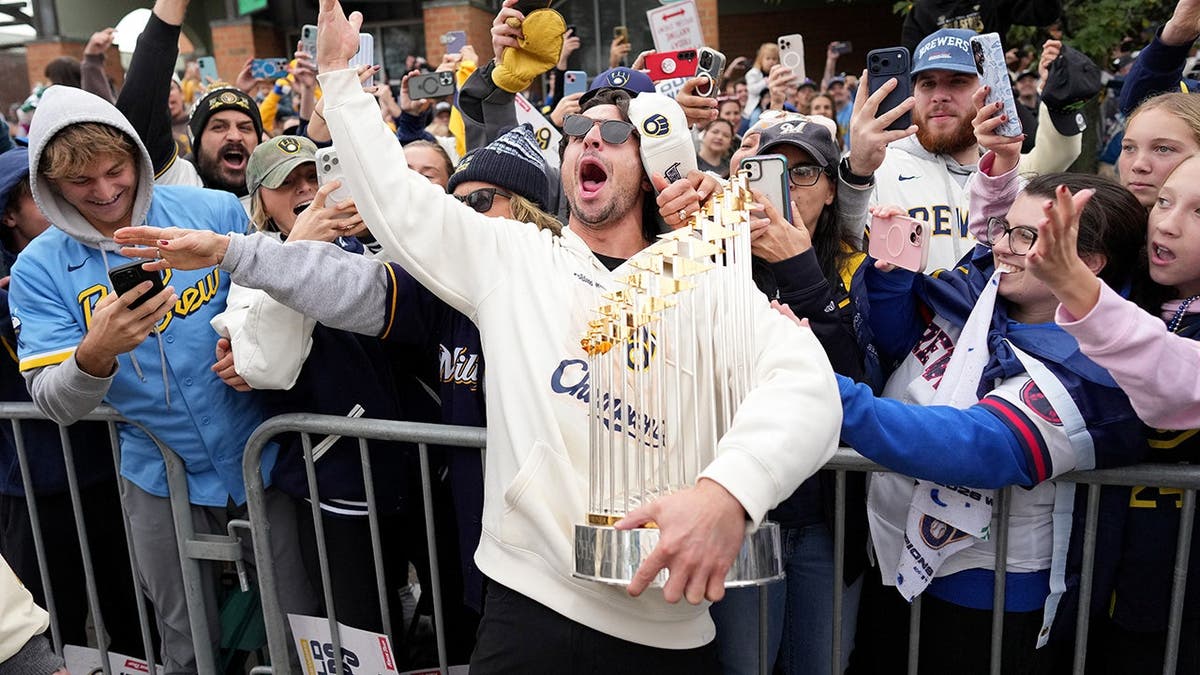
Sal Frelick of the Milwaukee Brewers celebrates with fans during the 2026 World Series Milwaukee Brewers Victory Parade on Oct. 30, 2026, in Milwaukee, Wis. (Patrick McDermott/Getty Images)
Obviously, we just completed a 2026 season in which the Milwaukee Brewers, long one of baseball's cheapest organizations, won the World Series in historic fashion. They went 11-2 in the playoffs, with their two losses coming by a combined total of just two runs. One in walk-off fashion. They were three outs away from becoming the first team to sweep the NLCS and World Series. That NLCS sweep came against the Los Angeles Dodgers and their $400 million+ payroll.
The Brewers beat the Tampa Bay Rays in the World Series, another one of baseball's cheapest teams. Yet the Rays have made the World Series three times since 2008 and twice since 2020. Here's how that compares to some of baseball's biggest markets over the last decade:
- Yankees - 1
- Mets - 0
- Giants - 0
- Red Sox - 1
- Cubs - 1
- Rangers - 1
- Nationals - 1
- Phillies - 1
The Rays have been a more successful organization at reaching the World Series over the past decade than every big market team other than the Dodgers and Houston Astros. Interesting.
The San Diego Padres, who have spent a fortune signing players like Fernando Tatis Jr., Manny Machado, Xander Bogaerts, Yu Darvish, Joe Musgrove, Jackson Merrill, rank in the top five in overall spending in the last five seasons. They have one win in the NLCS to show for it and no World Series appearances.
Still, there are many who remain convinced that a cap would ultimately make a substantial difference in outcomes, relative to the capitalist market baseball currently enjoys. Thankfully, The Athletic put that theory to the test. And got what might be surprising results for some fans.
Eno Sarris, one of their baseball writers, used regression analysis to "determine the state of competitive balance."
His methodology "incorporated three ways of measuring market size — payroll, Nielsen’s ranking of television markets and a metric the union and league created called "market score" — and examined the correlation between those factors and outcomes on the field."
He then compared the current state of baseball to the NBA and NFL, the two salary capped leagues. And while there's a lot to unpack, here's the topline, as the article states: "First, the math largely supports the Players Association’s position that baseball’s competitive balance is already strong."
"Second, MLB’s vision for a competitive-balance utopia might not level the playing field the way fans expect," it adds.
There is a caveat; sustained spending over time can correlate, at least somewhat, with higher winning percentages in the regular season. But the complaints about "big markets" are mostly false, they found.
"If, instead of payroll, the analysis uses 'market score' — a metric that factors in TV audiences, population and median household income — then market size explains almost nothing statistically about how a team will fare."
Analytics and modern front offices have also closed the gaps between teams, their analysis found, and the postseason is mostly random, making regular season success of little value.
"In addition, when compared to the past, team win-loss records are more clustered in the middle, with fewer clubs occupying the extremes," the article reads. "At the same time, outcomes in the playoffs also remain much more random than those in the regular season."
As for a salary cap, even the league's top executives admit that it will do little-to-nothing to create more playoff appearances for small-market teams. Morgan Sword, an executive VP and one of commissioner Rob Manfred's top economics experts, told The Athletic, "No, no, I don’t think it would (lead to more playoff appearances), and I don’t think it needs to."
Welp. There goes the marketing campaign.

Major League Baseball Commissioner Robert D. Manfred Jr. speaks during the MLB and Dominican Baseball Federation announcement at the 2025 Winter Meetings in Orlando, Fla., on Dec. 8, 2025. (Mary Holt/WBCI/MLB Photos)
They also found that the gaps between teams is smaller than it's been in decades, thanks to the latest CBA, which increased revenue sharing and luxury tax penalties, giving smaller market teams more money for existing.
But what about the most "important" thing; does spending more money buy more wins? Well, they found that over the past five seasons, payroll "accounted for 17 percent of the variance in a team's winning percentage in a single season."
CLICK HERE FOR MORE OUTKICK SPORTS COVERAGE
What does that mean? Sounds like a lot, doesn't it? In actuality, it correlates to a similar relationship between "team wins and how many ground balls a team's pitchers induce."
In other words, yeah, it doesn't matter very much.
Then there's market size. Their analysis also found that "Market score explains just 1 percent of the variance in MLB wins."
THE CRAIG CARTON SHOW–UNFILTERED, UNAPOLOGETIC AND UNMISSABLE. DOWNLOAD HIS DAILY PODCAST NOW!
During this current five-year CBA, 24 of 30 teams made the playoffs. Of the six that didn't, three each came from big and small markets. Sure sounds like competitive balance, doesn't it?
You can also compare outcomes between baseball, the NFL, and NBA. Payroll doesn't matter much in the NFL, because the cap and floor are so close, but the outcomes between all three sports are similar anyway. Baseball actually has more parity because it's harder to reach the postseason than it is in the other leagues.
80% of MLB have reached October in the past five years, 78% of the NFL, 90% of the NBA. 38% of MLB's bottom half payroll teams have reached the postseason, while it was 54% in the NFL and just 28% in the NBA. But again, it's harder to make the postseason in baseball, because only 12 of 30 teams get to October. The NFL and NBA are trophies for everyone leagues, which makes the results far less impressive.
SIGN UP FOR THE DAILY OUTKICK NEWSLETTER
There is no relationship between market size and playoff outcomes, they found, and the minimal relationship between payroll and postseason success is entirely because of one team: the Dodgers. "If the Dodgers were removed from the calculation, there would be no statistically significant relationship since 2022 between payroll and playoff winning percentage," the article explains.
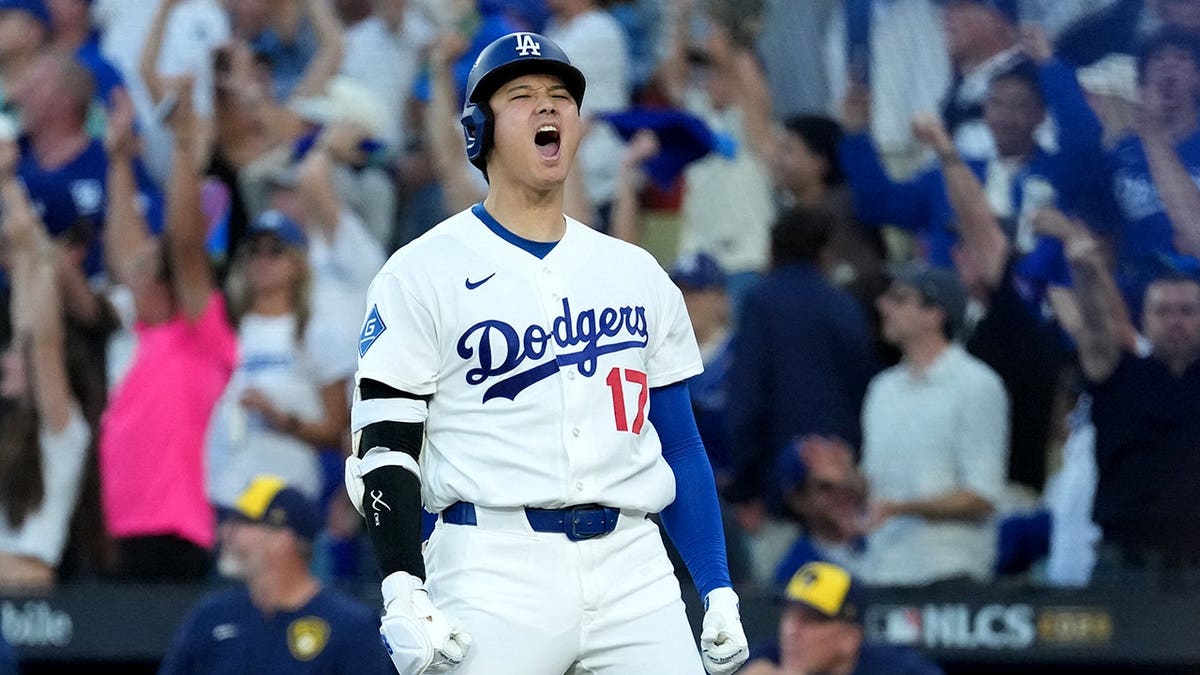
Los Angeles Dodgers designated hitter Shohei Ohtani reacts after hitting a three-run home run during the second inning against the Milwaukee Brewers in Game 4 of the NLCS for the 2026 MLB playoffs at Uniqlo Field at Dodger Stadium in Los Angeles, Calif., on Oct. 15, 2026. (IMAGN IMAGES via Reuters Connect)
Before going into what this all means, it's worth revisiting one quote from Rays starter Drew Rasmussen about the Brewers. After the series, he told reporters that they were "the best team I've ever played at the Major League level."
OUTKICK IS NOW AVAILABLE ON THE FOX NEWS APP: CLICK HERE TO DOWNLOAD
Are the 2026 Brewers the best baseball team ever? No, and they may or may not have been the best baseball team in 2026. But the point is that over a small sample size, like a postseason or postseason series, any playoff team can be "the best team" the opposition has ever played. That's what makes baseball so unpredictable. It's more prone to hot streaks and cold streaks than any other.
So what's the takeaway here?
A salary cap would not "fix" baseball, because there's nothing to fix. Spending money helps, a little, when it comes to winning more games in the regular season. It doesn't matter, at all, when it comes to reaching or winning the World Series. The Dodgers' wins were down to the same factors as any other championship team: a combination of talent, timing, and luck. Which is why they've reached the postseason 17 times since 2008 and have failed to win a title 14 of those times.
The relationship between payroll and winning percentage is akin to the advantage a team gets from having a lot of groundball pitchers. Which is to say, not much.
It's easy, and lazy, to say that you can "buy" a championship. You can't. If you sustain higher levels of spending for years, you can have a small advantage with a regular season winning percentage. You will buy yourself no advantage whatsoever in the postseason.
The fact that owners have convinced fans of something that is not true is devastating not just for the fans who refuse to learn accurate information, but because they are using that support to justify an extended shutdown. That's a disaster. And even worse, it's an unnecessary one.
