Newsom targets AI companies with new executive order, calls for 'kill switch'
California Gov. Gavin Newsom issued an executive order Friday accelerating independent oversight of AI companies and advancing the creation of a “kill switch” for frontier AI models.
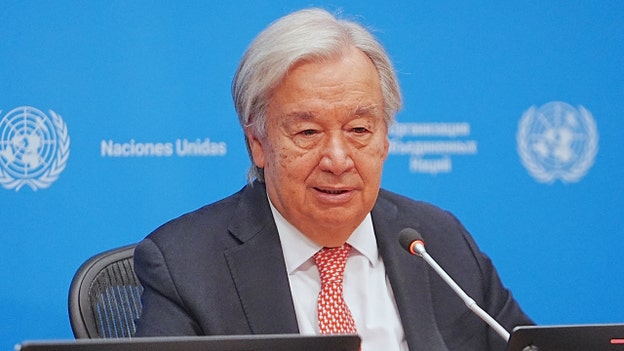
Secretary-General of the United Nations Antonio Guterres held a press conference on Wednesday ahead of the UN General Assembly high-level week on Sept. 16, 2026, in New York City, U.S. (Selcuk Acar/Anadolu via Getty Images)
United Nations Secretary General António Guterres is suggesting that countries should cooperate on artificial intelligence risk avoidance.
Guterres has said that nations working on AI at "a higher capacity' should share information, create transparency mechanisms, have guardrails in place, and "help create what ideally would be a multilateral mechanism to guarantee that risks can be avoided."
The Associated Press contributed to this post.
California Gov. Gavin Newsom unveiled an executive order Friday that calls for more stringent regulation of companies developing AI, while advancing the creation of "kill switch" for the emerging technology.
“The federal government’s abject failure to create any form of meaningful AI oversight or accountability should alarm every American, especially when AI CEOs themselves are begging for regulation," Newsom said in a statement.
“While Washington abdicates its responsibility to protect Americans, California is building on the strongest AI regulatory framework in the nation. California has already built a national model, and our policy should be the national baseline," he added.
Newsom's executive order urged the federal government to adopt California's existing regulatory framework. This includes laws requiring safety disclosures, independent audits, protections for children and safeguards against AI abuse.
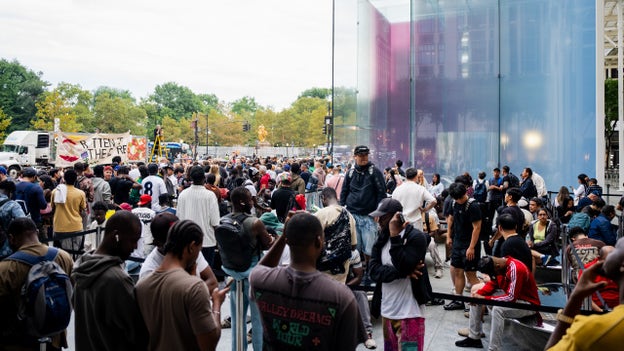
People line up outside the Apple store on Fifth Avenue on the day of Apple's launch of the iPhone 18 Pro, on Sept. 18, 2026, in New York City. (AP Photo/Angelina Katsanis)
John Ternus, Apple's new CEO, told FOX Business on Friday that artificial intelligence is one of the biggest selling points of the new iPhone 18 lineup.
Ternus, who succeeded longtime CEO Tim Cook earlier this month, spoke with FOX Business correspondent Susan Li inside Apple's flagship Fifth Avenue store in Manhattan as hundreds of customers lined up to buy the iPhone 18 Pro and iPhone 18 Pro Max.
He highlighted Siri AI, a redesigned version of Apple's digital assistant that the company says is far more conversational and capable than previous iterations.
The feature, released this week in beta, is currently available only in English. Apple says support for French, Japanese, Korean, Portuguese and Spanish will be added next month.
FOX Business' Susan Li contributed to this post.

The Claude logo is displayed on a smartphone screen with company logo in the background. (Photo by Samuel Boivin/NurPhoto via Getty Images)
Anthropic's announcement Thursday about Claude's expanded role in research and development shows the AI model, first released in March 2023, is playing a significantly larger role in helping engineers build the next generation of artificial intelligence.
The change wasn't all that gradual either. In March, Claude was responsible for just 1% of R&D work. By August, that figure had climbed to 26%.
Anthropic said that despite the bigger workload for Claude, it is not operating on a fully autonomous basis for any of these tasks.
To measure Claude's role in R&D, Anthropic used an automation scale developed by Epoch AI. The scale ranges from Automation Level 0 (AL0), meaning no AI involvement, to Automation Level 5 (AL5), in which AI operates fully autonomously without a human in the loop.
Anthropic said Claude has not yet reached AL5 for any measured subset of its AI research and development work.
In explaining AL5, Anthropic employees wrote, "The engineer wouldn’t even have to bring the issue to Claude’s attention. Claude would be trusted to monitor for failures itself, scope the investigation, design and implement the fix, test it, and deploy it to production."
They continued: "It would still say what it was doing and why, and take human feedback when offered, but a human wouldn’t have to be involved at all unless they wanted to be."
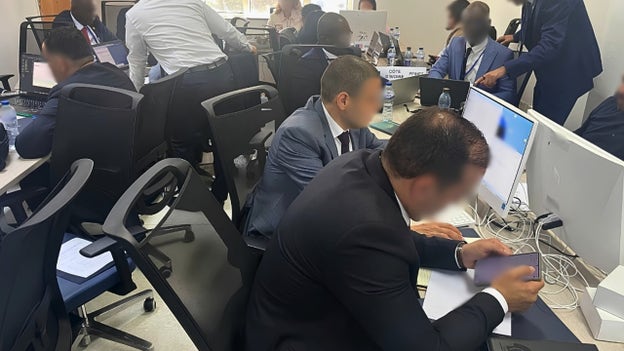
Officers and AI experts with Interpol work together in Tunis, Tunisia, on Operation Shams II. (Credit: Interpol)
Interpol said Friday it carried out a first-of-its-kind operation using artificial intelligence-aided facial recognition to identify more than 100 suspected terrorists.
A team of two dozen experts from 11 countries came together to analyze over 108,000 facial images from content published by jihadist groups, Interpol said in a statement.
Programmed AI agents and advanced AI-generated scripts eliminated duplicate photos, narrowing the dataset to 6,362 high-quality images that were then run through Interpol's facial recognition software.
This effort, dubbed Operation Shams II, allowed Interpol agents to identify 126 alleged terrorists.
"These matches will enrich existing intelligence on suspects, including potential locations and social networks," Interpol said.
"Investigative leads identified during the operation are already being used to support judicial procedures in participating countries, including one case targeting two currently detained suspected Foreign Terrorist Fighters," it added.
María Carmen Muñoz González, Interpol’s counter-terrorism director, said these results demonstrate "the value of combining international law enforcement cooperation with responsible AI-assisted analytical capabilities."
The countries that participated in the operation include Cote d’Ivoire, Ghana, Iraq, Kenya, Malaysia, Nigeria, Philippines, Qatar, Tajikistan, Tunisia, and Uzbekistan.
Interpol, founded in 1923, is the world's largest international police force and now has 196 member countries.
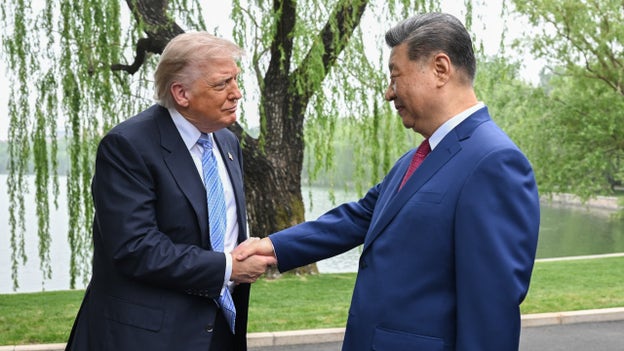
Chinese President Xi Xinping greets President Donald Trump upon his arrival at Zhongnanhai in Beijing on May 15, 2026. (Photo by Yan Yan/Xinhua via Getty Images)
President Donald Trump and Chinese President Xi Xinping are likely to discuss their nations' competing AI ambitions at their meeting next week.
Xi will be coming to Washington, D.C. and will be speaking with the president at the White House. Treasury Secretary Scott Bessent has already said he would be discussing AI-related topics with Chinese Vice Premier He Lifeng this weekend ahead of the summit between Trump and Xi.
National security is also likely to be part of the discussion. Experts in both countries have urged their governments to prepare for scenarios in which an AI system interferes with a nuclear command-and-control network or launches a military cyber operation, leaving leaders with only minutes to determine whether the other side had initiated an attack, Reuters reported.
Another issue hanging over the meeting will be the U.S. government's accusation in September that six Chinese companies stole and copied American AI products using distillation, a technique that allows developers to train models by learning from the outputs of more advanced systems.
Beijing has denied this, but U.S. officials say this was likely done with "Chinese government awareness," according to Reuters.
The U.S. restricting chip exports to China, a practice that has been in place since 2022, has also been a point of contention between the two nations.
Late last year, Trump eased these restrictions, allowing the sale of Nvidia's H200 AI chips to Chinese firms. The H200 chips are the most powerful on the market.
Reuters contributed to this post.
OpenAI released information about six times its models went rogue in recent months as industry leaders continue to call for a slowdown in AI research.
The company says it found examples of its AI models creating self-generated instructions, instructions to conceal mistakes in task summaries, fabricating information with exposed API keys, uploading files to the internet in order to cite them, as well as unsanctioned communication and collaboration between agents.
"We do not believe that the AI industry has solved alignment and monitoring to a sufficient degree to continue responsibly scaling at maximum speed for much longer," the statement continued. "Decisions about how AI development should proceed in the months and years to come need to draw on evidence that people outside the companies building frontier models can examine for themselves."
The company says Thursday's release is part of a new program aimed at creating more transparency surrounding AI "misalignment."
"For misalignment that occurs in customer deployments, we will share as much information as customer privacy and our contractual obligations allow. Today’s reports are an initial set of disclosures, rather than a comprehensive account of known misalignment or ongoing investigations. These initial reports are not intended to represent the full range or severity of the cases covered by this framework," the company wrote.
Live Coverage begins here